


Más Información



Mexico’s government
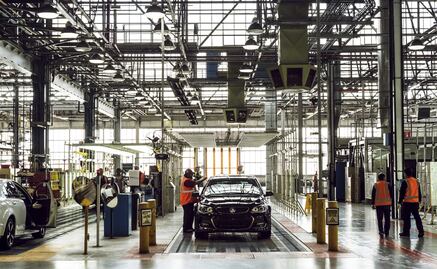
said on Tuesday it had reached an agreement with Brazil on the free trade of light vehicles, subject to a 40 percent regional content requirement, paving the way for more open commerce between Latin America’s two biggest economies.
The agreement takes effect on Tuesday and the content requirement would be subject to current formulas for calculation, the economy ministry said in a statement. The statement did not provide details on the formula.
Mexico has been seeking to diversify trading partners since U.S. President Donald Trump warned of the possible death of the North American Free Trade Agreement (NAFTA) that has underpinned Mexico’s foreign trade for a quarter-century.
The economy ministry said Mexico racked up a trade surplus in the auto sector with Brazil worth $868 million last year, three times the total recorded in 2017.
Brazil’s auto industry is protected by subsidies and import taxes. Antonio Megale, president of automotive sector trade group Anfavea , told newspaper O Estado de S. Paulo he would have preferred to delay the free trade agreement by three years.
Announcing new investments in Brazil on Tuesday, Carlos Zarlenga, General Motors’ top executive for South America , said the Brazilian industry was competitive and benefited from its scale, but noted that taxes were so high that 50 percent of the automaker’s revenue in the country was spent on taxes.
In addition to the Brazil agreement, Mexico has renewed auto trade quotas with Argentina for the next three years, after which there will be free trade, the ministry said.
In the first year the auto trade quota between Mexico and Argentina would increase by 10 percent, followed by a five percent increase in the second year, then another five percent in the third and final year.
Since 2012, Mexico’s fast-growing auto sector has had to contend with curbs in trade with Brazil and Argentina, whose governments have sought to protect local manufacturing.
dm

Noticias según tus intereses
[Publicidad]
[Publicidad]